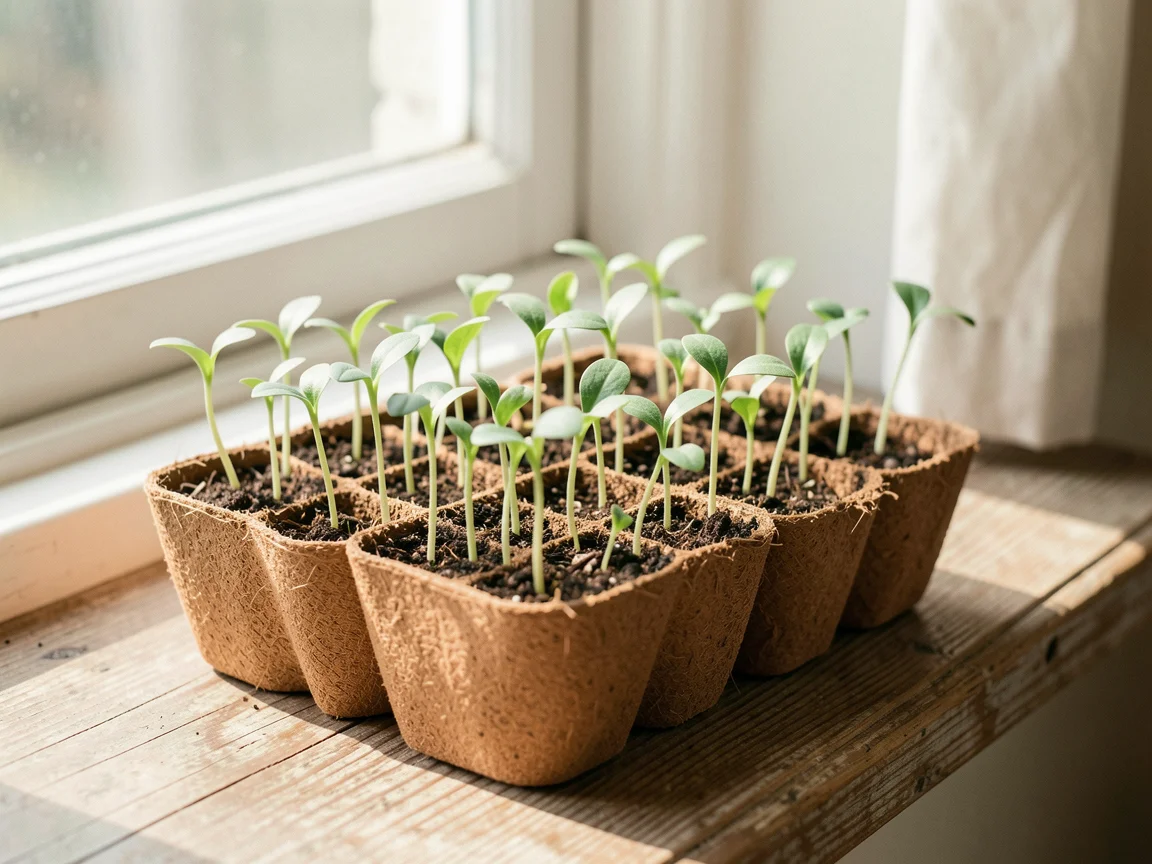
Every November someone sends us a photo of tomato seedlings leaning toward the glass at 40 degrees. The stems are four inches tall and thin as thread. The window faces south, the tray gets turned every morning, and the plants still stretch. We understand the appeal. A windowsill is free, and the seed packet makes indoor starting sound easy. For lettuce and kale, it can be. For tomatoes and peppers, the window is the weakest link.
Quick answer. A bright south-facing window can raise lettuce, kale, and basil into sturdy transplants. It rarely gives tomatoes and peppers enough light. Keep tomato and pepper soil at 75 to 85F and lettuce below 70F, keep the trays two inches from the glass, and buy a $30 LED shop light only if you start more than a few dozen plants or your window gets under four hours of direct sun.
What a south-facing window actually gives you
South is the right exposure for winter starting. From November through February, the sun tracks low across the southern sky, so a south window gets direct light most of the day. In June the sun rises north of east and sets north of west, and the same window gets almost no direct sun. We start seeds in the cool months.
Glass and screens take a cut. A dirty pane or an insect screen can halve the light you assume. A porch overhang cuts more. Distance matters more. Light falls off fast, and a tray two feet back from the glass gets roughly a quarter of what a tray on the sill gets. Keep seedlings almost touching the glass, then move them back as they grow.
A free lux meter app is rough but consistent. At noon in December, point it at the leaves. Under 1,000 lux is dim. Around 10,000 is workable for lettuce and herbs. Tomatoes and peppers want more, and Miami gives only about 10 hours and 40 minutes of December daylight, so the window cannot reach the 14 hours tomatoes prefer.
Warm soil first, then the coir kit
Germination is about soil temperature before light. Tomato seed comes up in about six to eight days at 75F and can take two weeks at 65F. Peppers are slower: three weeks at 65F, about ten days at 80F. Lettuce is the opposite. It germinates best at 60 to 70F and refuses to sprout above 80F, so the refrigerator top is the wrong place.
A 72F room does not mean 72F soil. A tray against a cold window can sit five degrees cooler. An instant-read thermometer at two inches into the mix tells you more than the thermostat.
The kit workflow is straightforward:
- Set one compressed disc in each cell and add warm water. Each fills a 1.5-inch cell in about ten minutes. Top up the water if a disc still feels dry in the middle.
- Fluff with the dibber, firm lightly, and tip off any standing water.
- Sow two seeds per cell at twice the seed’s diameter. Lettuce goes on the surface, pressed in, because it needs light to germinate.
- Label the cultivar and date. Cover with the dome and keep tomatoes and peppers at 70 to 80F, lettuce cooler.
- Open the vents at the first sign of green, then remove the dome once most cells sprout. Move the tray to your brightest spot.
- Feed at half strength once the first true leaves appear. Coir has no nutrients. Most people skip this.
A Coco Coir Seed Starter Kit has 24 cells, 24 discs, labels, a dibber, and a vented dome. Pot up into a 4-inch pot of Living Soil Potting Mix when two sets of true leaves have opened.
Why seedlings stretch, and what actually helps
A leggy seedling is telling you it is short of light. The stem elongates between leaves. The leaves stay small and pale, and the whole plant leans toward the glass. Once the stem is long and weak, it does not thicken back up. You manage it, or you start over.
What helps:
- Move the tray closer to the glass, not just near the window. Two inches is better than two feet.
- Turn the tray a quarter turn every morning so they grow evenly instead of leaning.
- Drop the night temperature to 60 to 65F. A cooler night slows stem stretch.
- Brush the seedlings with your hand for a minute a day, or run a small fan on low. The movement strengthens stems.
- Do not feed more nitrogen. It makes the problem worse.
Tomatoes are forgiving. When you pot up, bury the stem up to the first leaves and roots form along it. Peppers and lettuce do not do that. A stretched pepper stays thin, and a collapsed lettuce seedling is not worth saving. Start those again with more light.
When a light earns its $30
Most patio gardeners do not need a grow light. If you are starting 12 lettuce plants and a few herbs, a south window will do. Buy a light when one of these is true:
- Your only window faces north or east.
- You are starting more than about 40 plants.
- You want stocky tomatoes and peppers before the end of February.
- Your seedlings stretch even when they touch the glass.
Skip the high-output grow fixture. A two-foot LED shop light with a 24-watt draw and a 4,000 to 5,000K color temperature costs $25 to $40. Hang it on a chain so you can raise it as the plants grow, keep it 6 to 10 inches above the leaves, and put it on a timer for 14 to 16 hours. Ignore claims that compare a 24-watt light to a 600-watt one. Look at actual draw.
A white shop light is easier to live with than a purple “grow” bulb. Plants use the same light you do.
Hardening off is a week of small steps
Seedlings raised indoors have thin cuticles and no experience with wind. Moving them straight to a patio in November can scorch the leaves in an afternoon, even in mild weather.
Start 7 to 10 days before transplant:
- Day one: one hour outdoors in shade, out of the wind.
- Days two through four: add an hour a day, still in shade or morning sun.
- Days five through seven: give them morning sun and a little breeze, and bring them in before the hottest part of the afternoon.
- Days eight through ten: leave them out overnight if the forecast stays above 55F for tomatoes and peppers, or above 45F for lettuce and kale.
Water more often once they are outside. A 4-inch pot in an 80F afternoon dries faster than on the shelf. Feed two days before moving them out, not on the day. In our experience, November wind does more damage than sun, so set the trays against a wall.
This week’s small task
- Measure the light at your brightest windowsill at noon with a free lux meter app and write the number on a sticky note.
- Set four coir discs in the tray, add warm water, and sow two ‘Little Gem’ seeds in each cell.
- Move your trays to within two inches of the glass, and put a book under short pots to raise them.