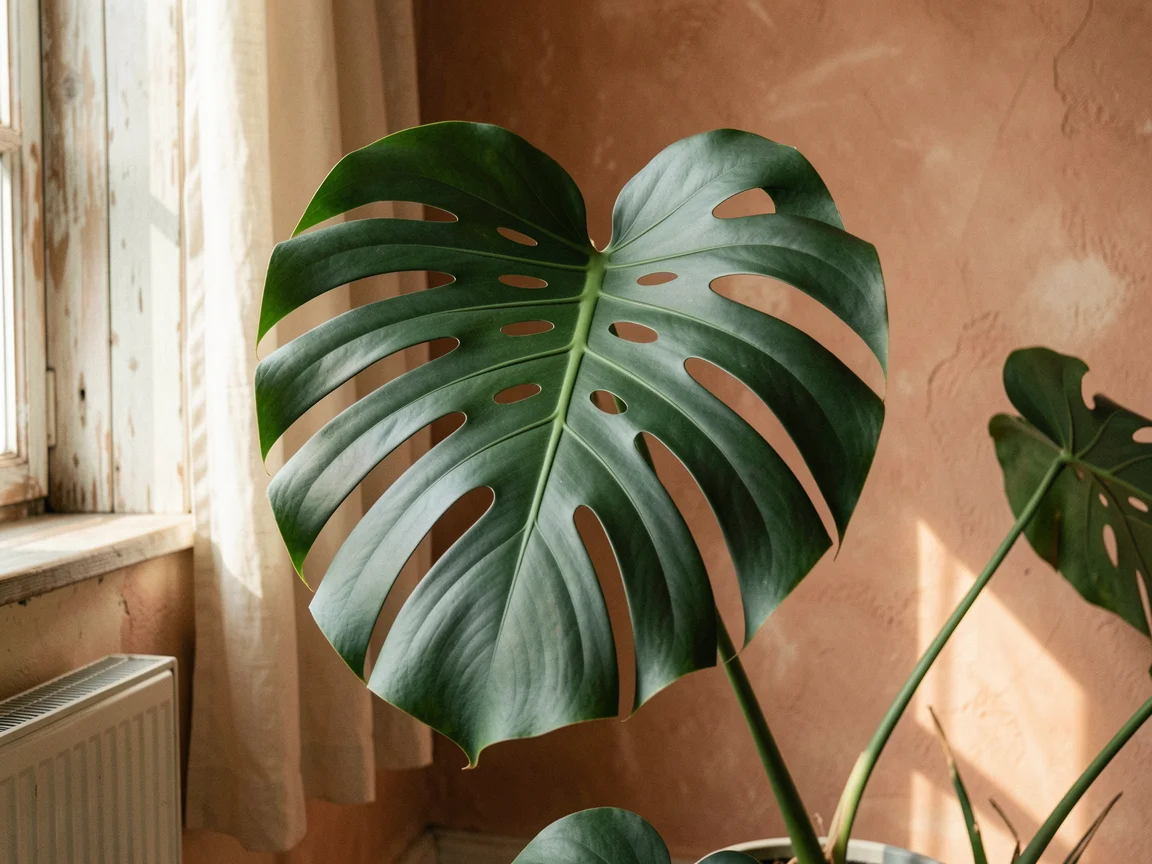
The monstera sits four feet from a window in a Fort Lauderdale apartment. Every leaf edge has gone brown and papery, and the owner has misted it twice a day since July. That detail usually comes last in the conversation, and it matters least. Crispy margins on a Monstera deliciosa are rarely a request for more water on the leaves. They mean the plant cannot move water from its roots to the far edge of a leaf fast enough. The cause is usually the air conditioning or the watering can.
Quick answer. Brown crispy edges are water stress, most often low indoor humidity combined with a mix that stays soggy. Split leaves are a separate subject: fenestration is genetics and light, not damage. Aim for 50 to 60 percent humidity, water by pot weight, and put the spray bottle away.
Brown edges and split leaves are not the same problem
A young Monstera Deliciosa puts out solid heart-shaped leaves for a year or two. The splits and holes, called fenestrations, arrive as the plant matures and gets enough light. A juvenile with no splits is normal. A mature plant in a dark corner may never split. Neither case is damage.
Brown tissue is different. When a leaf margin goes dry and papery, that tissue is dead. Common causes include a mix that stays wet long enough to kill fine roots, a mix that has gone hydrophobic and sheds water at the surface, fertilizer salts built up near the pot wall, and air dry enough to pull moisture out of the leaf faster than the roots replace it. Soft brown patches that spread are usually infection. Crisp edges that stay put are usually culture.
What 40 percent humidity does to a leaf
An air-conditioned room in South Florida commonly sits between 38 and 45 percent relative humidity. The air conditioner is doing its job: it condenses water out of the air and sends it down the drain.
At 75 F, air at 40 percent humidity holds roughly half the water vapor of air at 75 percent humidity. A leaf does not care about the number on a gauge. It cares about the gradient between the water inside the leaf and the air outside it. Dry air pulls water off the leaf surface, and the edges, farthest from the veins and the roots, lose the race.
Monstera deliciosa comes from the understory of southern Mexico and Panama, where humidity stays above 70 percent most of the year. We cannot match that in a condo with the AC running. We can get close enough that new leaves come out clean. Old damage does not heal, so judge the fix by new growth.
Water by weight, not by calendar
Lift the pot before you water. Then lift it after. A 10-inch pot with dry mix is noticeably lighter, often by a third. That difference is the most reliable moisture meter you own.
The chopstick test works too. Push a wooden chopstick to the bottom, leave it ten minutes, pull it out. Dark and cool means wet. Dry means water.
Water thoroughly. Pour until water runs out the drainage holes, then empty the saucer after 20 minutes. Never let the pot stand in a puddle; that is how root rot starts. In a warm room with active growth, a 10-inch monstera usually needs water every 7 to 10 days. In winter, with the AC running and growth slowed, 12 to 18 days is normal. The calendar is a guess. The weight is data.
A bone-dry mix can turn hydrophobic. Water runs down the pot wall and out the bottom without wetting the root ball. Set the pot in a tub for 30 minutes to soak upward, then drain.
Light, humidity, and a few habits to drop
An east window gives two to four hours of gentle morning sun and bright indirect light after that. That is close to ideal. Set the plant one to three feet back from the glass and pull a sheer curtain if the leaves feel hot to the touch.
A south window works with distance. Three to five feet back is usually safe in a South Florida summer, when 2 pm sun through glass can scorch a leaf in an afternoon. In December, move the plant closer, within two feet. July light is not January light.
Rotate the pot a quarter turn every week or two. Monstera leans hard toward light, and an unrotated plant develops a permanent tilt with a bare back. Six to eight hours of bright indirect light is the target. If new leaves come out smaller than the last one, the plant wants more light, not more fertilizer.
For humidity, buy a $10 to $15 hygrometer and put it beside the pot. A small ultrasonic humidifier set six to eight feet away, running a few hours a day, can hold a closed bedroom near 55 percent. Do not point the mist at the foliage. A pebble tray adds perhaps 3 to 5 percentage points in the immediate area, which is honest but modest.
Skip the misting. Droplets evaporate off a leaf in 10 to 20 minutes and raise room humidity by an amount too small to measure. Wet foliage in still air gives bacterial leaf spot an opening. If the goal is humidity, misting is the wrong tool. If the goal is dust, wipe the leaf with a damp cloth once a month and let it dry.
Other habits undo the work. Do not water on a fixed weekly schedule, do not fertilize a struggling plant, do not polish leaves with oil, and do not move the pot every few days looking for a better spot. Monstera adjusts to a light level in two to three weeks. Moving it restarts the clock.
Repot on the plant’s schedule
Slide the plant out of its pot in late spring and look at the root ball. Repot when you see these:
- Roots emerging from the drainage holes
- Water running straight through the pot within seconds
- A dense coil of roots around the outside of the mix
- A pot that tips under the weight of the leaves
If the mix falls away and the tips are white, give it another season. Monstera tolerates tight roots. It does not tolerate drowning.
When you do repot, follow this order:
- Water the plant two days before, so the root ball holds together.
- Choose a pot two inches wider in diameter, no more.
- Add an inch of Living Soil Potting Mix to the bottom.
- Center the root ball, fill around it, and press gently. Do not compact the mix.
- Water until it drains, then put the plant in bright indirect light.
A chunky mix matters more than the pot. Garden soil compacts into something like brick. A Speckled Stoneware Planter dries slower than terracotta, which suits a monstera in a dry room, as long as it has a drainage hole. A pot without one is a bucket.
This week’s small task
- Lift the pot, water it thoroughly, and lift it again. Feel the difference in your hands. Ten minutes.
- Move the plant at least three feet from any air conditioning vent or return. Five minutes.
- Put a hygrometer beside the pot and note the reading at 3 pm for three days. Fifteen minutes total.