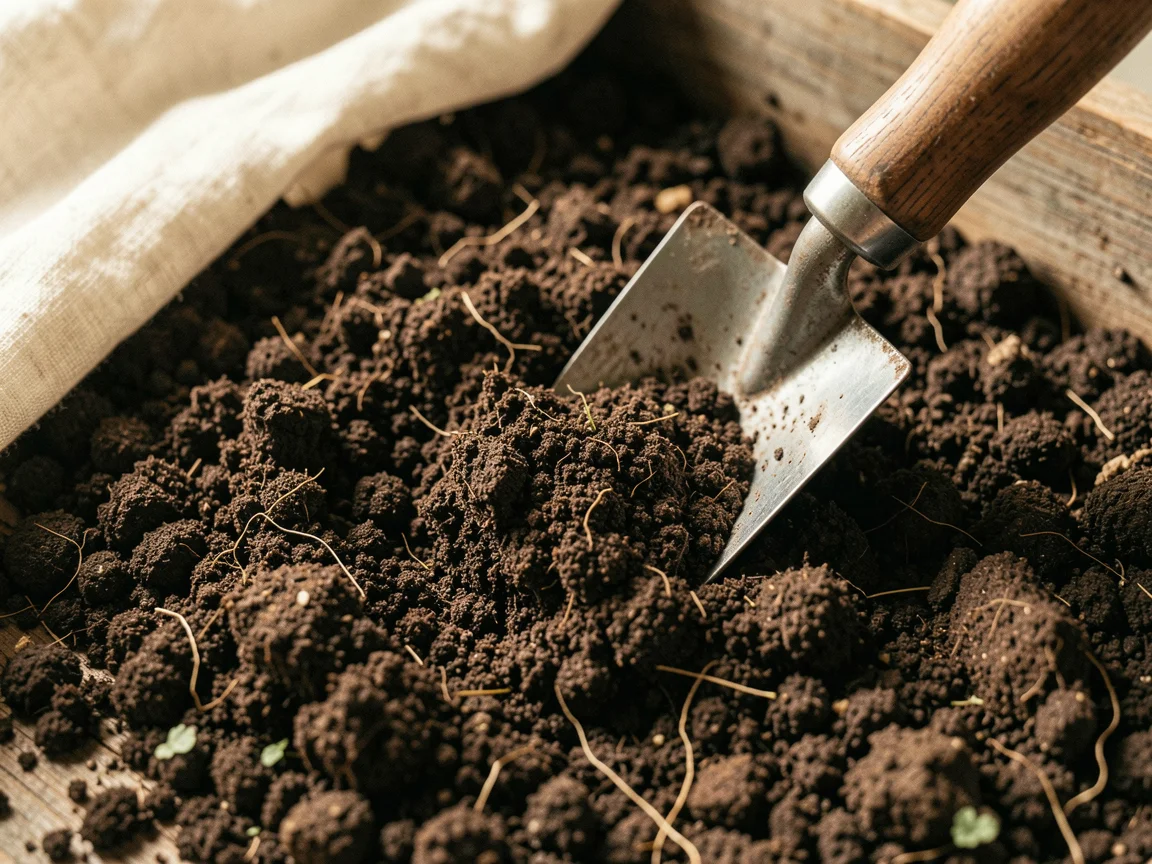
Every October the same thing happens on our patio. The cherry tomato in the big terracotta pot stops setting fruit, the lowest leaves go pale, and the surface of the mix has sunk an inch below the rim. Nothing is wrong with the plant. The pot ran out of food. A twelve-inch pot holds a few gallons of mix, and a heavy feeder can work through the reserves in eight weeks. More liquid fertilizer is not the fix. Rebuilding what is inside the pot is.
Quick answer. Container mix is not garden soil, and it never turns into it. Rebuild it once a year instead: about five parts coir, two parts leaf mold or sifted compost, one part worm castings, one part perlite. Kitchen scraps go into a lidded bucket with bokashi bran, then get buried in a spare pot to finish.
A pot is not a patch of ground
Garden soil is roughly 45 percent mineral, 5 percent organic matter, and half pore space split between water and air. Dig it and it holds structure, worms, fungal threads, and a reserve of minerals that took decades to build.
A pot holds none of that. Bagged potting mix is mostly bark, coir or peat, and perlite. It is a structure for roots, not a pantry. Once the plant fills the pot with roots, there is little left to draw from. Every watering pushes a little more out the drainage hole. That is why the tomato yellowed in week eight. The mix was still wet and still light, and it had nothing left to give.
The fix is not a bigger dose of blue powder. It is replacing the organic fraction before it collapses.
The inputs that earn their space
You can buy all of these, or make one of them for free.
- Leaf mold. The cheapest input on this list, and the one most people bag up and leave at the curb. Rake leaves into a black bag, punch a dozen holes, add a cup of water, and tie it shut. In South Florida heat it breaks down in four to six months. Use it wherever a recipe calls for compost.
- Worm castings. Buy them by the bag. A handful per gallon of mix is enough. Castings are not a fertilizer in the NPK sense. They are biology, and biology is what keeps a container mix alive between repottings.
- Composted manure. Aged, crumbly, and smelling of earth, never fresh. Fresh manure burns roots and can carry weed seed. One part manure to four parts base mix is plenty.
- Coco coir. A compressed block rehydrates in a bucket of water in about twenty minutes and gives you roughly two gallons of damp fiber. Rinse it once if the block came from a salty source. The coir in our Coco Coir Seed Starter Kit works for this as well as for seed trays.
- Perlite. Cheap and ugly. Skip it and the mix compacts into a brick by July.
If you want a known base to build on rather than mixing from scratch, Living Soil Potting Mix already has the bark and drainage handled. Treat it as the five parts and add the rest.
A bucket, not a bin
A compost bin needs cubic feet of material and a pitchfork every week. A five-gallon bucket needs a lid and a corner of a balcony. This is bokashi, which is fermentation, not decomposition. It does not sterilize anything, and it does not turn scraps into soil on its own. It pickles them so they stop smelling and finish fast once buried.
- Drill eight quarter-inch holes in the bottom of a five-gallon bucket and four near the rim. Nest it inside a second, intact bucket to catch liquid.
- Put two inches of damp potting mix in the bottom. Add kitchen scraps, then a tablespoon of bokashi bran, then press the whole layer down with a plate. Air is the enemy here.
- Seal the lid. Every two or three days, drain the liquid from the outer bucket into a watering can and dilute it 1 to 20 before using it on established plants.
- After two to three weeks the scraps look pickled and smell sour, like vinegar. Dig a hole eight inches deep in a spare pot of mix, tip them in, and cover with three inches of soil. Wait three weeks before planting in that pot.
A bucket that smells like garbage instead of vinegar went anaerobic. Add more bran, press harder, and drain more often. If liquid sits in the outer bucket for a week, the whole batch turns.
This is where the Terracotta Pot Trio earns its keep. The middle pot, empty and parked behind the others, is a fine finishing vessel for one bucket of scraps.
A mix, by the bucket
Volume, not weight. A two-gallon bucket is the easiest measure, and one batch fills two twelve-inch pots with a little left over for topdressing.
| Component | Measure | Job |
|---|---|---|
| Rehydrated coco coir | 5 | Holds water without going dense |
| Leaf mold or sifted compost | 2 | The organic reserve |
| Worm castings | 1 | Biology and slow nitrogen |
| Perlite | 1 | Air that survives a season of watering |
| Organic granular fertilizer | 1/2 cup per bucket | Feeds for six to eight weeks |
Mix it on a tarp, wetting as you go, until a handful holds together and breaks apart when you poke it. Fill pots to within an inch of the rim. Water slowly until it runs clear out the bottom, then let the pot drain somewhere it can make a mess.
What stays out
Some things do not belong in a bucket, a bin, or a trench under a shrub.
- Meat, fish, dairy, and cooking oil. They rot rather than ferment and bring animals.
- Dog and cat waste, which carries pathogens a backyard bucket will not kill.
- Tomato and pepper foliage with blight or leaf spot.
- Weed seed heads, alive and ready.
- Pressure-treated sawdust, glossy paper, and anything labeled compostable that is actually PLA plastic. It needs industrial heat.
- Citrus peels in quantity. A few are fine. A bag of them slows the ferment.
This week’s small task
- Bag two gallons of dry leaves, punch six holes in the bag, wet it, and set it out of sight. Fifteen minutes, and it becomes leaf mold by spring.
- Drill the holes in a five-gallon bucket and start the first scrap layer with a handful of bran. Twenty minutes.
- Topdress every pot with one inch of worm castings and water it in slowly. Fifteen minutes, and it buys you four weeks.