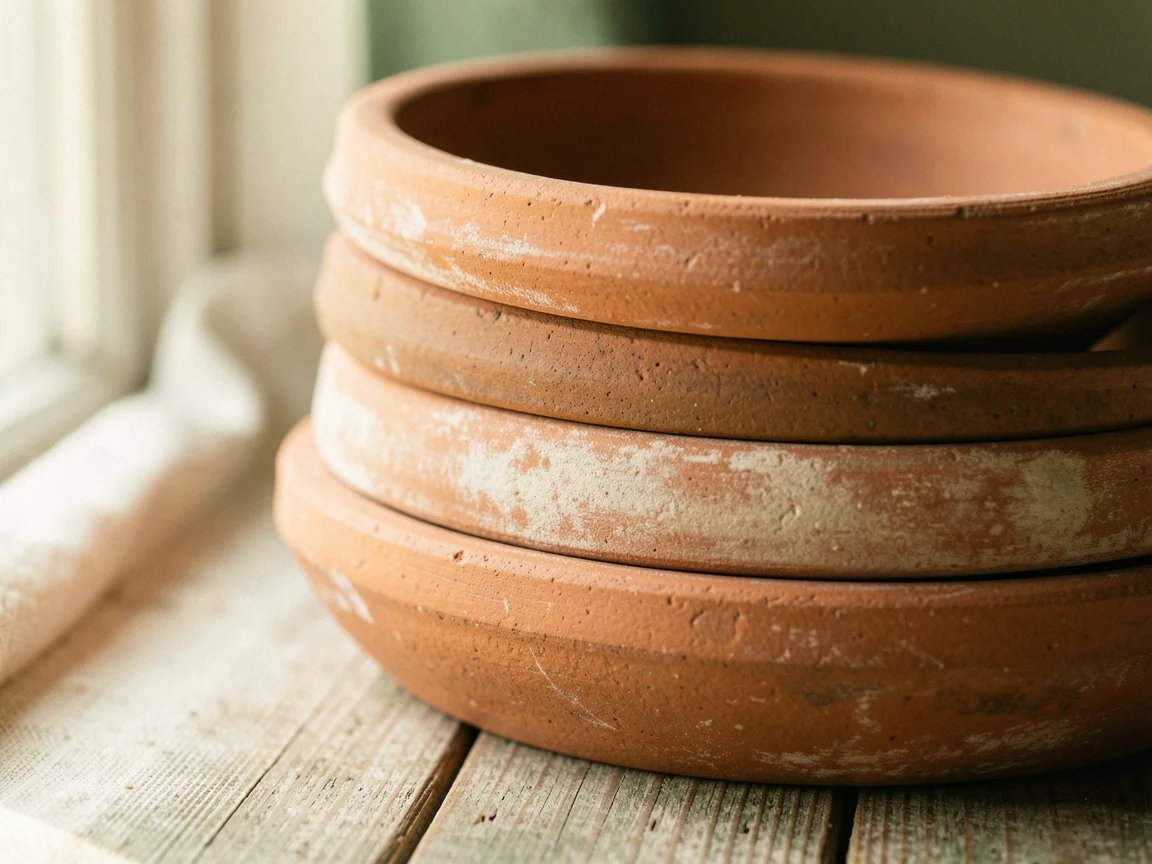
Two pots sat on the same patio all summer, one terracotta and one glazed stoneware, both 10 inches wide, both planted with Genovese basil on the same day. The glazed pot held water for four days. The terracotta one was dry by Wednesday morning, and the basil in it wilted every afternoon around three. That is the trade in one sentence: terracotta gives roots air and takes water away fast. Whether that helps or hurts depends on what you planted and how many afternoons you are home in July.
Quick answer. Terracotta is porous. Water moves through the wall and evaporates into the air, so the mix dries faster, roots near the edge get oxygen, and dissolved salts collect as a white bloom on the outside. That suits rosemary and plumeria, and anything else that wants to dry out between waterings. Basil does better in glazed stoneware, and so do ferns and seedlings.
The wall is a wick
Terracotta is fired at a relatively low temperature, roughly 1,800F to 2,000F, which leaves the clay open and slightly absorbent. Water inside the pot moves toward the dry outer face by capillary action, reaches the surface and evaporates. The pot is not leaking. It is breathing, slowly, all day.
Two useful things follow. First, the root zone gets air. Roots need oxygen as much as water, and a pot that dries from the edges pulls air in behind the water. Second, the evaporating wall cools the root ball a few degrees, which is not nothing on a west-facing patio in August.
One thing to know before planting: a bone-dry pot will pull water straight out of fresh mix. Soak it in a bucket for twenty minutes, or water the planted pot twice on the first day, until the clay stops hissing.
Watering changes more than you think
The same pot is a different pot in June and January. In the rainy season, a 10-inch terracotta in full sun may still need water every day, because a wet wall dries fast once the sun hits it. In the dry months, every fourth or fifth day is closer. Small pots dry faster than large ones, so the 4-inch pots in the Terracotta Pot Trio need a check twice a day in July.
Saucers are where people undo the whole thing. A terracotta pot sitting in an inch of drained water will pull that water back up through the base, so the bottom of the root ball stays wet while the top looks dry. Use a saucer to catch the runoff, then empty it once the pot stops dripping.
The cheap tray trick. Quart deli containers from the grocery cost nothing, and one cut down to about an inch and a half makes a saucer for an 8-inch pot. For a 4-inch pot, a yogurt lid works. If you want something that looks intentional, a plastic nursery tray from any garden center is two dollars and does not chip when you move the pot. Set the pot on two chopsticks or a few pebbles so it is never touching the standing water.
The white crust is salt, not mold
That pale ring around the rim and the chalky streaks down the side are salts. Your tap water has minerals in it, and South Florida water comes out of limestone and carries plenty of calcium. Every time the pot dries, a little of that moves to the surface and stays there. Fertilizer adds to it.
The bloom is harmless. It is not a sign of disease, and it does not need to be sealed in or scrubbed off for the plant’s sake. If you do not like the look, brush it dry with a stiff brush, or wipe it with equal parts white vinegar and water. On a planted pot, keep the vinegar on the outside and rinse well, because a vinegar soak will move into the mix and shift the pH.
It comes back. That is the nature of an unglazed pot, and after a season most people stop noticing. Green algae on the rim in the rainy season is normal too, and a sign that side of the pot stays damp.
Some roots hate drying out
Basil is the loudest example. It has thin leaves and a fast growth rate, and it has no patience for a dry root ball. Cilantro, parsley, lettuce, ferns and most seedlings are the same. In terracotta they need water every day in summer, and if you miss a day the plant tells you at three in the afternoon.
Plants that want steady moisture, not a dry cycle:
- Basil and cilantro, which wilt before they brown
- Parsley and lettuce, whose leaf edges go crisp first
- Ferns and calathea, which brown at the tips
- Seedlings in 4-inch pots, where there is barely any mix to hold water
If your heart is set on terracotta for one of these, drop a plastic nursery pot inside it and use the clay as a cachepot. That kills most of the drying benefit, which is the point, but it also means the pot is doing decorative work rather than horticultural work. Say that plainly to yourself before you spend money on a big one.
Sizing up, and when glazed wins
Move up about 2 inches in diameter at a time. A plant in a 6-inch pot goes to an 8, then a 10. Jumping from 6 to 14 leaves a wide ring of wet mix with no roots in it, and that mix sours before the roots arrive.
Terracotta gets heavy and expensive above 14 inches. A 16-inch pot with wet mix weighs well over 40 pounds, and the rim chips if you drag it across concrete. This is where glazed stoneware earns its price. It is fired hotter, so it holds water, and it is the better choice for anything that wants steady moisture. It also wins on a big pot you will have to move, and on a windy balcony where the extra weight helps. The Speckled Stoneware Planter is glazed inside and out.
Glazed has costs too. Roots can circle a smooth wall faster than they will in rough clay, so check for that at repotting. A glazed pot also gives you no visual warning that the mix is dry. You will be lifting it, same as before.
Whichever you choose, water with something that does not blast the mix out of the pot. The Olive Enamel Watering Can has a long spout that reaches past the leaves.
This week’s small task
- Weigh a terracotta pot and a glazed pot of the same size, dry, one in each hand. That difference is what you are signing up to water. Five minutes.
- Scrub the salt bloom off one pot with a dry brush and set it back. Watch how long it takes to return. Ten minutes.
- Cut a quart deli container down to an inch and a half and use it as a saucer under your smallest pot. Punch a notch in one side so it does not hold water against the base. Ten minutes.